Hiring a web developer? 7 things to check first
Published · 7 min read
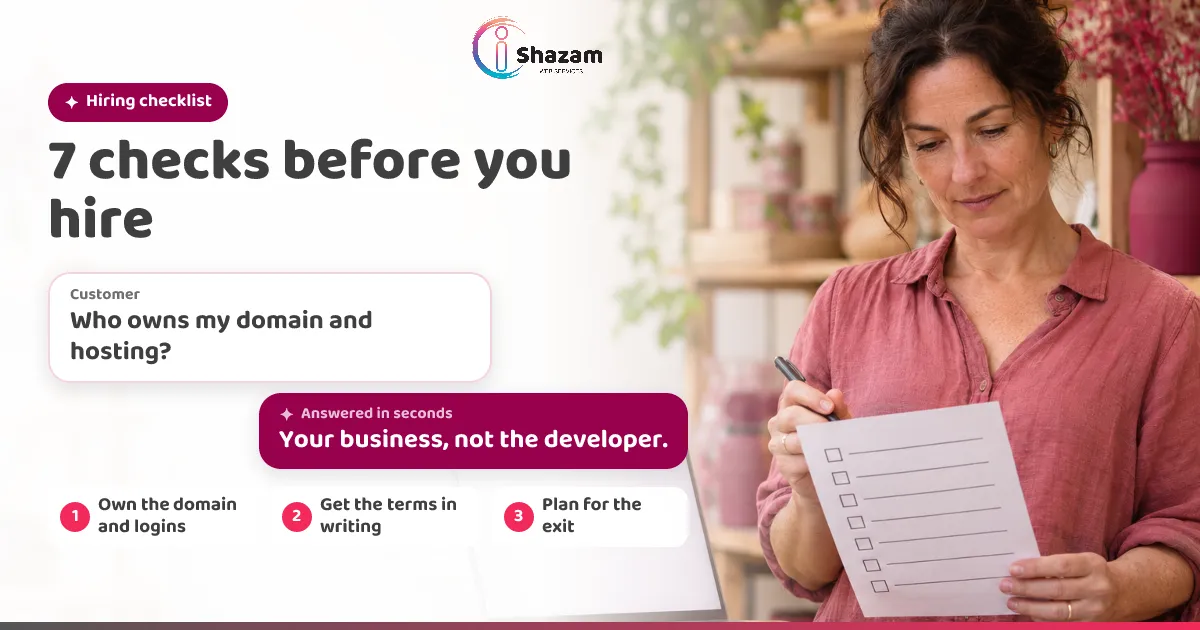
Before you pay a web designer, developer or automation freelancer, check seven things: who owns the domain and accounts, where your customer data goes, who you can reach and when, what is in writing, what it really costs, what happens if they stop replying, and who supports the site after launch. Most of these take about ten minutes to check.
Why check before you sign?
A website can outlive the person who built it, and so can your customer data. In February 2016 a Gold Coast web developer, Graphics Online, went into liquidation. The liquidator put the number of affected clients at about 600. Many could not reach their domains or work out who hosted their site (SmartCompany).
Outside sources also show third parties are a growing risk. Verizon’s 2025 global study found third parties were involved in 30% of data breaches, double the year before (Verizon).
Check 1: Who owns the domain, hosting and accounts?
Put them in your business’s name, with you as the admin. A developer can apply for a .au domain as your agent, but the registrant must be the business the name is held for, and a .au licence cannot be leased or passed to someone else (auDA Licensing Rules, ss 2.2.4 to 2.2.6 and 2.11.12). Register it under your company’s name if you have one, or your own name if you are a sole trader. You renew a .au licence, so put the renewal date in your calendar. The WA Small Business Development Corporation also says to confirm you own the domain, especially if the developer registered it, and to collect every username and password (SBDC WA).
Check 2: Where will your customer data go?
Enquiry forms, bookings and email lists are personal information. If a contractor overseas handles them, the Privacy Act’s rule on overseas disclosure (APP 8) usually applies. The OAIC says giving personal information to an overseas contractor is, in most circumstances, a disclosure (OAIC, para 8.12). Your business stays accountable for what the overseas recipient does with it (OAIC, para 8.60).
Many small businesses, those with turnover of $3 million or less, are not covered by the Privacy Act unless an exception applies (OAIC, Chapter B). Check the current position with the OAIC before you rely on it. Either way, ask in writing: where is the data stored, who can see it, and does any subcontractor see it?
Check 3: Who is your contact, and when are they working?
Ask who answers your messages, how fast, and in which hours. Melbourne is on AEDT (UTC+11) in November. The Philippines is 3 hours behind and India is 5.5 hours behind. These are simple time differences, not a survey. A short daily overlap is worth asking for, whoever you hire.
Check 4: What is in writing?
A written contract is proof of what you both agreed. Business.gov.au says it should cover the work and timeframes, the payment amount and when it is paid, how either side can end the contract, and what happens if there is a dispute (business.gov.au). Also get the ownership of the website and its copyright in writing. Ask for answers to your questions in writing too, and keep a copy (SBDC WA).
Check 5: What will it really cost?
The quote is rarely the total. Ask about hosting charges, domain renewal, paid images and fonts, the number of changes included, and any monthly fee. The WA guide lists these as common hidden costs (SBDC WA). Pay in milestones, not all up front.
Check 6: What happens if they stop replying?
Ask for a handover plan before you pay the final invoice. It should list the files, source code, logins and the contract end date. The Graphics Online case shows why. A developer quoted in the same story advised affected businesses to find the host first, then vet any new developer (SmartCompany).
Check 7: Who supports the site after launch?
Ask who fixes a broken booking form in six months. Get the support terms, the response time and any monthly fee in writing. A cheap build with no support plan can cost more in the long run.
Questions to ask before you sign
Copy these into your email to them:
1. Can I see three sites you have built, and speak to one past client?
2. Whose name will the domain and hosting be in?
3. Where will my customer data be stored, and who can see it?
4. Who owns the code, the design and the copyright once I have paid?
5. What is included, what costs extra, and what does a change cost?
6. Who is my contact, and what hours do you work?
7. If you are unavailable for two weeks, what happens to my site?
8. Who supports the site after launch, and at what cost?
How to check past work
Open two or three sites they list, on your phone as well as a laptop. Check that they load fast and work on mobile. Ask who built each one, because the developer is often credited in the footer. The WA guide suggests asking for samples and for the names of existing clients you can contact, and treating reluctance to share as a warning sign (SBDC WA).
Red flags
- They want to create the domain or hosting in their own name.
- They will not share logins, or they say you do not need them.
- They cannot say where your data is stored.
- They will not put the scope, price or ownership in writing.
- They ask you to pay by an unusual method, or to refund an “overpayment” (Scamwatch).
- They are reluctant to give you past work or a client to call.
When an overseas freelancer or a marketplace works well
Overseas and marketplace hires can work well. A fixed, small job with a clear brief, a portfolio you can check and a paid test task is a good fit. Large projects with a proper contract and a project manager also work well. Deloitte’s 2024 survey lists access to skilled talent as a main reason companies outsource (Deloitte). The seven checks above apply to every option, including us.
How iShazam handles each point
- Accounts: you own every account. Your domain, hosting, email and ad accounts stay in your name from day one. See our website services.
- Writing: you get a written quote and a written agreement before any work starts. See how to contact us.
- Time zone: we work in Melbourne time, so we are in the same working day as you.
- Privacy: we handle your customer data under Australian privacy rules. See our custom tools.
- Check it yourself: our free tools show how your business looks to customers and to AI tools, at no cost.
FAQ
Can I hire a freelancer who lives overseas? Yes. Keep the seven checks, and be clear about data. Ask where the data is stored, and for a written answer.
Do I need a lawyer to check the contract? For a small website, a clear written agreement is a good start. For large projects or customer data, check with a lawyer or the OAIC.
Who should register my domain? Your business. Your developer can apply on your behalf, but the registrant must be the business the name is held for (auDA Licensing Rules).
Quick recap
- Own the domain, hosting and accounts in your name.
- Get the contract, scope, price, data location and handover in writing.
- Ask about hidden costs, support and what happens if they disappear.
Sources
- OAIC, APP Guidelines Chapter 8: Cross-border disclosure of personal information (v1.3, October 2025), paras 8.12 and 8.60. https://www.oaic.gov.au/privacy/australian-privacy-principles-guidelines/chapter-8-app-8-cross-border-disclosure-of-personal-information/
- OAIC, APP Guidelines Chapter B: Key concepts, para B.5 (small business operator, $3,000,000 turnover). https://www.oaic.gov.au/privacy/australian-privacy-principles-guidelines/chapter-b-key-concepts
- WA Small Business Development Corporation, Choosing a website professional (undated). https://www.smallbusiness.wa.gov.au/templates-tools-guides/guides/choosing-a-website-professional
- auDA, .au Domain Administration Rules: Licensing (Policy 2019-01, approved 22 June 2026; ss 2.2.4 to 2.2.6 and 2.11.12). https://www.auda.org.au/au-domain-names/au-rules-and-policies/au-domain-administration-rules-licensing-2/
- business.gov.au, Types of contracts (undated). https://business.gov.au/legal/contracts-and-tenders/types-of-contracts
- SmartCompany, Hundreds of SMEs left in the lurch after website developer enters liquidation (18 February 2016). https://www.smartcompany.com.au/finance/hundreds-of-smes-left-in-the-lurch-after-website-developer-enters-liquidation/
- Verizon, 2025 Data Breach Investigations Report press release (23 April 2025). https://www.verizon.com/about/news/2025-data-breach-investigations-report
- Deloitte, 2024 Global Outsourcing Survey. https://www.deloitte.com/global/en/issues/work/global-outsourcing-survey.html
- Scamwatch, Buying or selling scams (undated). https://www.scamwatch.gov.au/types-of-scams/buying-or-selling